




Have you heard of the term “Industrial Waste Collection and Transport License” ?
Since it’s not something you encounter often in everyday life, many people may find it unfamiliar or hard to understand.
However, this license plays a crucial role when it comes to disposing of waste generated by companies, stores, construction sites, and renovation projects.
✦・┈┈┈┈┈┈┈┈ ・✦
“Industrial Waste Collection and Transport License” — what exactly is that?
“Industrial waste” refers to waste generated through business activities, such as at companies, stores, factories, and construction sites.
For example:
Wood and gypsum board from construction sites
Concrete and rubble from demolition work
Metal scraps from factories
Waste plastics
Materials replaced during equipment installation work
These types of waste are treated differently from household garbage and must be properly disposed of as “industrial waste” in accordance with the law.
✦・┈┈┈┈┈┈┈┈ ・✦
On the other hand, furniture, home appliances, and daily necessities discarded from households are classified as “general waste” .
In other words, even though they may look like the same “garbage,” the disposal methods and applicable laws differ depending on whether the waste originated from a household or from business activities.
So, what exactly is the “Industrial Waste Collection and Transport License”?
This is a license required to collect industrial waste generated through business activities from customers and transport it to an appropriate processing facility.
Not just anyone can transport this waste freely — only businesses that meet the standards set by law and have received a license from the prefectural government (or other authority) are permitted to do so.
For this reason, when construction companies, contractors, renovation companies, real estate companies, and facility management companies need to dispose of waste materials or unwanted supplies, it’s essential to entrust this work to a licensed operator.
If you hire an operator without the proper license, it could lead to improper processing or illegal dumping.
Should issues such as illegal dumping occur, responsibility may extend to the waste-generating business as well, so choosing an operator based solely on “low price” is not advisable.
To ensure peace of mind, it’s important to confirm whether the operator holds the necessary license.
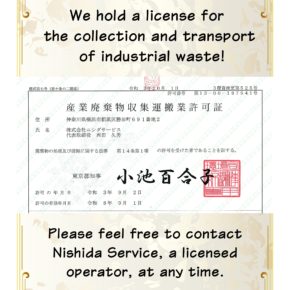
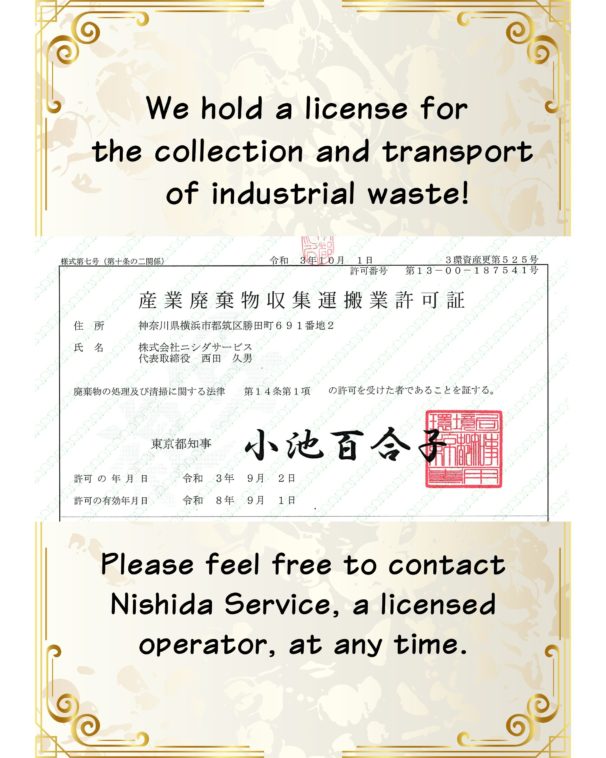
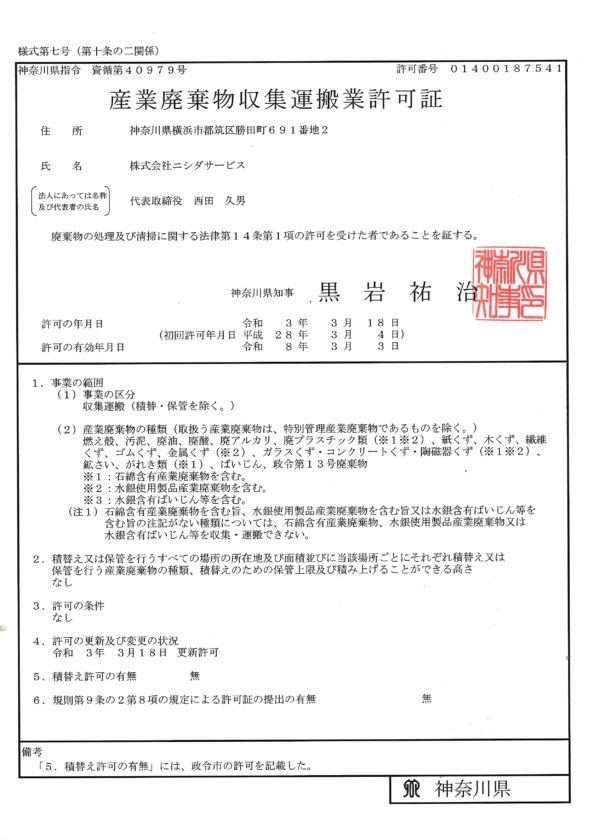
At Nishida Service, we hold the following license to properly collect and transport industrial waste:

Tokyo Metropolitan Industrial Waste Collection and Transport License No. 13-00-187541
Kanagawa Prefecture Industrial Waste Collection and Transport License No. 01400187541
These licenses are not something you simply obtain once and then forget about.
Operators must comply with the law, maintain proper management practices, and continue conducting business in accordance with the established rules.
At Nishida Service, we comply with all relevant laws and take full responsibility for transporting industrial waste entrusted to us by our customers to appropriate processing facilities.
In addition to industrial waste, we also handle a wide range of requests, including unwanted item removal, abandoned property clearance, vacant house cleanup, and the tidying of stores and offices.
“Is this considered industrial waste?”
“I’m not sure about the difference between household waste and business waste.”
“Can you also take care of construction debris?”
If you have any questions like these, please feel free to contact us.
✦・┈┈┈┈┈┈┈┈ ・✦
At Nishida Service, we take the time to carefully explain each customer’s individual situation and propose the appropriate solution.
To ensure our customers can request our services with peace of mind, we place great importance on complying with the law and handling every job responsibly.
If you’re having trouble with industrial waste disposal or business waste collection, please feel free to contact Nishida Service, a licensed operator, at any time.