




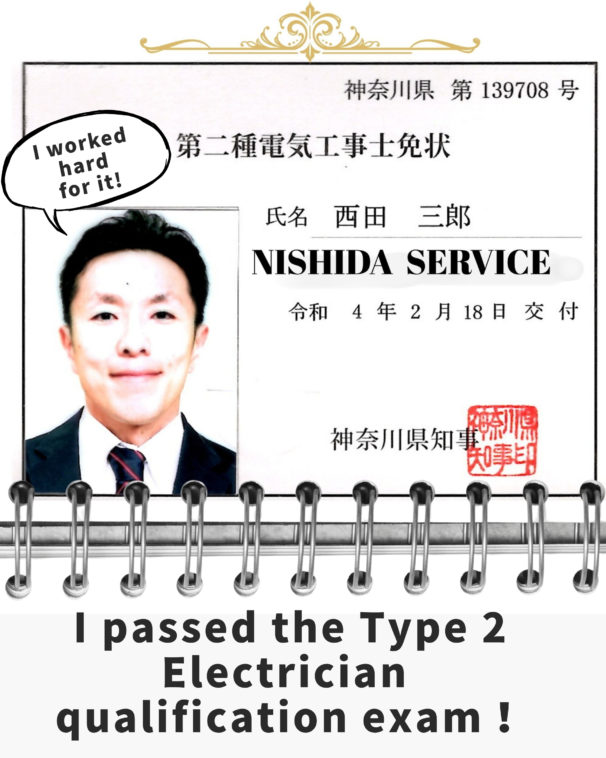



Hello! This is Nishida, Sales Manager at Nishida Service.
A little while ago, I obtained the Class 2 Electrician License.
My work is primarily focused on sales, so I’ve generally left the technical, on-site expertise to our skilled tradesmen in-house. As a result, there have been times when I wasn’t able to explain the technical details myself.
In sales, I often receive questions from customers about the details of electrical work, and there are many opportunities to propose the best solutions based on their needs. In situations like these, I wanted to be able to serve our customers with more accurate knowledge, which is why I decided to pursue this certification.
✦・┈┈┈┈┈┈┈┈ ・✦
A Study Period Made Possible by the Pandemic
I began studying for the certification right in the middle of the COVID-19 pandemic. Since it was a time when non-essential outings were being discouraged, I was able to secure solid blocks of study time—staying at the office after work or studying at home after dinner. Looking back, it turned out to be good timing for pursuing this certification.
✦・┈┈┈┈┈┈┈┈ ・✦
What Is a Class 2 Electrician License?
The Class 2 Electrician License is a national certification that authorizes the holder to perform electrical work, wiring work, and equipment maintenance in homes, shops, and small factories.
In fact, even work that may seem simple at first glance—such as replacing an outlet or switch in your home—cannot legally be performed by anyone without this qualification.
I know many people enjoy DIY projects, but please be aware that even electrical work in your own home may require a licensed professional in certain cases.
✦・┈┈┈┈┈┈┈┈ ・✦
The Written Exam: Past Questions Are the Fastest Path to Success
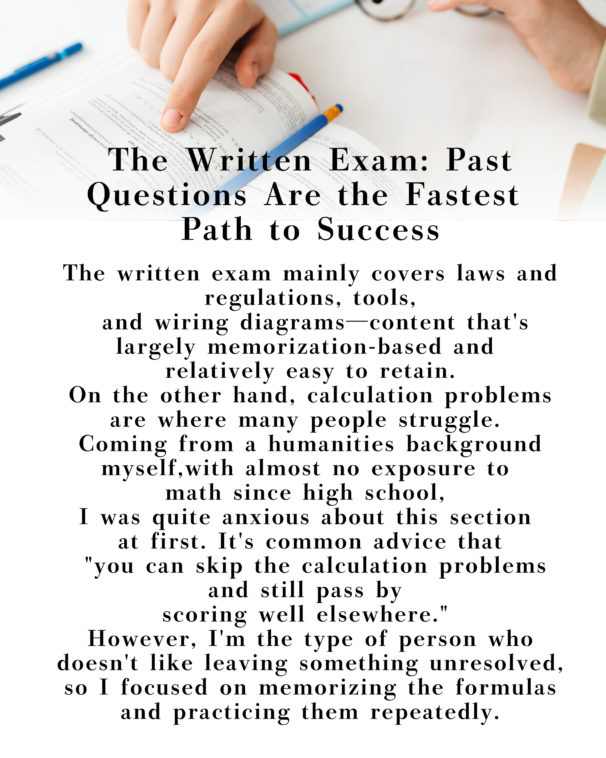
The written exam mainly covers laws and regulations, tools, and wiring diagrams—content that’s largely memorization-based and relatively easy to retain.
On the other hand, calculation problems are where many people struggle. Coming from a humanities background myself, with almost no exposure to math since high school, I was quite anxious about this section at first.
It’s common advice that “you can skip the calculation problems and still pass by scoring well elsewhere.” However, I’m the type of person who doesn’t like leaving something unresolved, so I focused on memorizing the formulas and practicing them repeatedly.
As it turned out, once I understood the formulas, the calculation problems were surprisingly easy to score on—even for someone like me who isn’t good at math. I’d say it’s a bit of a waste to give up on them from the start.
My study method was simple: repeat past exam questions as much as possible. Over the course of about a month, I worked through ten years’ worth of past exams, going through them more than twice. Although the exam itself is two hours long, I practiced until I could complete a full set of questions in about 15 minutes, which allowed me to approach the actual exam with confidence and plenty of time to spare.
✦・┈┈┈┈┈┈┈┈ ・✦
The Practical Exam: Practice Is Everything
Once you pass the written exam, the next step is the practical skills exam. Working from a given circuit diagram, you actually assemble wiring using electrical cables and fixtures.
Using specialized tools such as pliers, cable strippers, and electrician’s knives, you strip the sheathing off VVF cables and correctly connect items like lighting fixtures, switches, and outlets. Since even a small wiring mistake can result in failing the exam, precision is essential.
I practiced using instructional videos from the YouTube channel “Hozan’s Electrician Exam Tiger” . The explanations are very clear, and I’d recommend it to anyone learning practical skills for the first time.
https://www.youtube.com/channel/UCZDbvLIZ4IqXNNy9gHA5sZA
✦・┈┈┈┈┈┈┈┈ ・✦
What I Felt After Earning the Certification
When I received my certificate after passing, I felt a great sense of accomplishment and confidence. Earning this national certification has allowed me to make proposals to customers with greater confidence, and I feel I’m now able to offer more accurate advice when customers come to me with questions.
In particular, when it comes to air conditioner relocation work during a move, cases involving voltage changes from 100V to 200V often require the kind of knowledge that comes with being a licensed electrician.
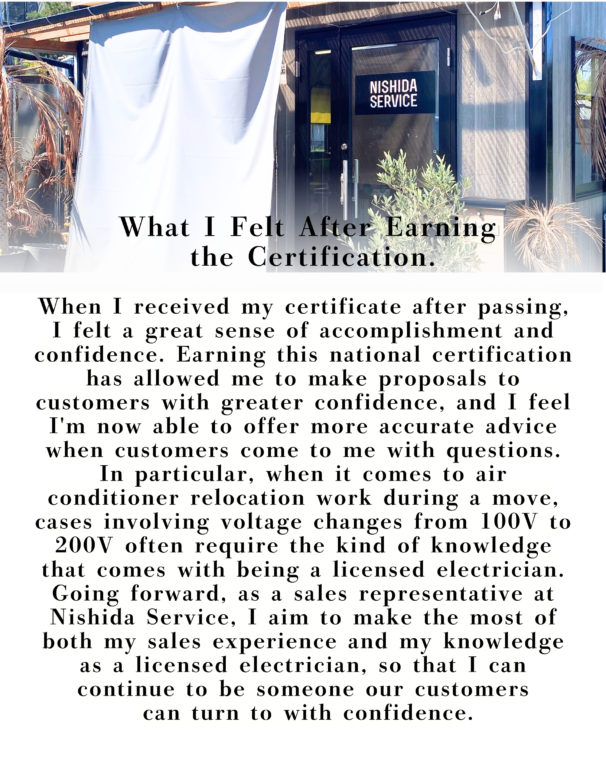
Going forward, as a sales representative at Nishida Service, I aim to make the most of both my sales experience and my knowledge as a licensed electrician, so that I can continue to be someone our customers can turn to with confidence.